As enterprise websites grow, their performance and security needs become increasingly complex. Consequently, traditional content management systems often struggle to meet these high demands. Fortunately, a modern architectural shift is transforming the industry. By adopting a Headless WordPress Enterprise solution, businesses can combine a powerful content management system with rapid front-end frameworks.
Understanding Headless Architecture
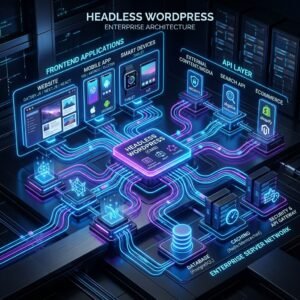
First and foremost, we must define what headless means. In a traditional setup, WordPress controls both the database (the back-end) and the visual layout (the front-end). In contrast, headless architecture decouples these two layers. Therefore, developers use WordPress solely as a content repository. Then, they fetch the content using the WordPress REST API or GraphQL to display it on a separate fast website.
Because the front-end is completely separate, you can use modern frameworks like React, Next.js, or Gatsby. As a result, your website loads almost instantly. You can explore our custom Next.js development services to see how we build high-performance decoupled platforms. Consequently, visitors receive a premium experience that drives engagement.
Why Enterprise Brands Choose Headless Systems
First, experience unmatched website security. Because your database is hidden behind an API layer, hackers cannot target the admin login page directly. Indeed, this decoupled setup eliminates most common vulnerabilities. Consequently, your enterprise data remains completely secure, protecting your brand from potential data breaches.
Second, enjoy ultimate design freedom. Designers are no longer restricted by theme templates or page builder limits. Instead, they can build custom interfaces that match your brand identity perfectly. For official developer guidelines on modern API integrations, check the Google Developers Network. This resources portal provides insights into building secure decoupled applications.
Scaling Content Across Multiple Channels
Additionally, headless systems allow you to distribute content to multiple platforms simultaneously. For example, the same WordPress dashboard can feed content to your main website, mobile app, and smartwatch screen. Consequently, your marketing team only needs to publish content once. This omnichannel capability makes Headless WordPress Enterprise setups highly efficient for large marketing teams.
Furthermore, decoupled websites enjoy superior uptime. If your front-end server experiences traffic spikes, your WordPress database remains unaffected. Therefore, your website continues to run smoothly, avoiding costly downtime during major marketing campaigns. In other words, headless sites offer unmatched operational resilience.
Improving SEO Performance and Load Times
In addition to security, SEO ranking is a major benefit of headless platforms. Traditional sites often suffer from slow server response times due to bloated plugins. However, headless architectures use pre-rendered static HTML files. Consequently, search engines crawl your pages easily, boosting your search rankings. Furthermore, fast page speeds improve your Google Core Web Vitals scores significantly.
Therefore, headless development is a powerful tool for competitive digital marketing. When pages load instantly, bounce rates drop and conversion rates increase. Consequently, enterprise businesses gain a major competitive advantage in search engine results. Thus, decoupled setups are highly recommended for large-scale marketing platforms.
Partnering with Decoupled Development Experts
In conclusion, headless technology offers the ultimate combination of speed, security, and scalability. If you want to future-proof your enterprise website with a modern decoupled system, we have the experience to build it. Please contact our enterprise development team today to start designing your headless platform!